

The Catalan School of Guitar Making

How Barcelona Developed Its Own Tradition
What turns a city into a centre of guitar making? Not a single design or one great maker, but workshops, apprentices, musicians and instruments through which ideas are passed down over decades. This is how Barcelona’s guitar-making tradition developed — the tradition now often referred to as the Catalan or Barcelona school.
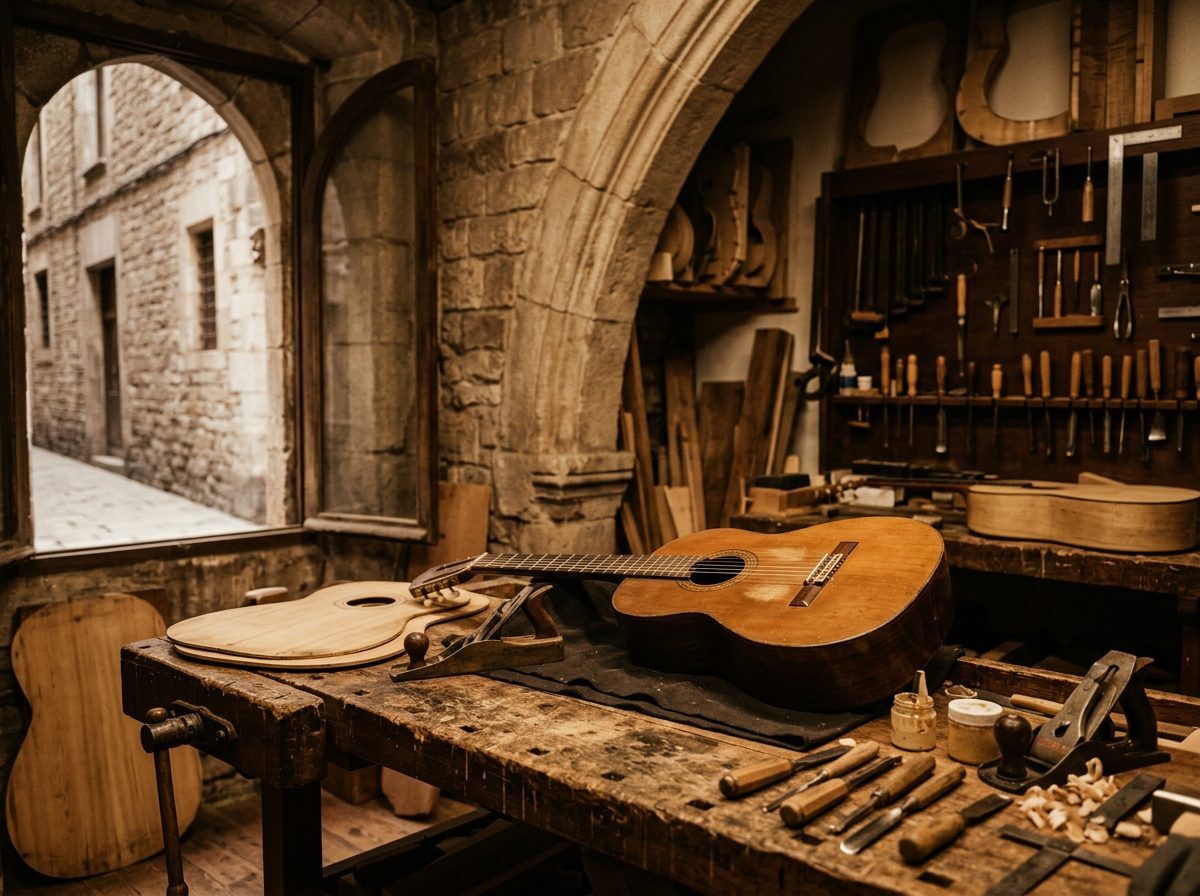
The term should be understood in a broad sense. This was never a formally established school governed by a fixed set of rules. Rather, it consisted of several interconnected lines of makers working in Catalonia, learning from one another and developing the Spanish guitar throughout the late nineteenth and twentieth centuries. This continuity is particularly clear in the stories of Enrique García, Francisco Simplicio and the generation that followed them. Other important workshops developed alongside this lineage, including Estruch, whose history in Barcelona dates back to 1880.
Barcelona as a Centre of Guitar Making
During the second half of the nineteenth century, the Spanish guitar was undergoing a crucial stage of development. The work of Antonio de Torres established a model for the concert guitar so influential that its fundamental construction principles continued to shape classical guitar making well into the twentieth century. The Metropolitan Museum of Art notes that later generations of Spanish makers worked within a tradition largely shaped by Torres, while modifying internal bracing systems, materials and individual construction details.
Barcelona became one of the cities where these ideas developed in their own direction. It had an active performing community and numerous workshops, while the transmission of craft from master to apprentice remained significant even after traditional craft guilds had disappeared. The Museu de la Música de Barcelona identifies this continuity between generations as one of the defining characteristics of Catalan instrument making.
One of the most important figures in the development of the Barcelona guitar tradition was, in fact, not born in Catalonia at all.
Enrique García: The Madrid Maker Who Changed Barcelona
Enrique García was born into a family of guitar makers and received his training within the Madrid Ramírez tradition. According to the Museu de la Música de Barcelona, between 1883 and 1895 he worked in Ramírez workshops alongside Manuel Ramírez and José Ramírez before moving to Barcelona and opening his own workshop.
His work is often regarded as a formative point in what came to be known as the Barcelona school. The San Francisco Conservatory of Music collection directly describes García as the founder of the Barcelona, or Catalan, guitar-making tradition. Among the construction features associated with his instruments, the source highlights the use of an additional eighth fan brace on the treble side of the soundboard to increase stiffness.
Fan bracing consists of wooden struts arranged inside the guitar body. They support the thin soundboard while also influencing how it vibrates. They remain largely invisible to the player, but for a maker they are one of the key means of controlling the mechanical behaviour of the top.
García’s importance extended far beyond the guitars he built himself. His approach influenced Francisco Simplicio, Enrique Sanfeliu and Ignacio Fleta. The history of the Catalan tradition therefore illustrates a fundamental characteristic of guitar making: a maker’s influence survives not only in his own instruments, but also in the decisions of those who examined them, repaired them, studied them or worked alongside him.
Francisco Simplicio: The Apprentice Who Continued the Workshop
Francisco Simplicio’s story is unusual partly because he entered professional guitar making relatively late. Born in Barcelona in 1874, he worked for many years as a cabinetmaker. It was only at around the age of 45 that he joined Enrique García’s workshop.
After García’s death, Simplicio took over the workshop. For several years he continued to use his teacher’s labels and described himself as García’s successor and sole pupil. This detail shows how important a lineage of craftsmanship could be: the maker’s name mattered, but so did the chain through which knowledge had been passed down.
Simplicio did not simply reproduce García’s solutions. Sources document his own experiments with both structure and decoration. Among his most unusual designs were guitars with two soundholes positioned on either side of the fingerboard instead of a conventional central soundhole. The idea was to alter the area of the soundboard able to vibrate freely.
This combination of respect for established Spanish construction and a willingness to experiment within it became one of the notable features of the Barcelona tradition.
From Simplicio to Fleta
In the following generation, Ignacio Fleta became one of its most important figures. His biography again demonstrates how approximate geographical definitions of a “school” can be. Fleta was born in the province of Huesca, but moved to Barcelona as a teenager, where he studied musical instrument making. His early work was not limited to guitars: he also built violins and cellos.
By the mid-twentieth century, Fleta had become one of Spain’s best-known guitar makers. Major concert performers, including Andrés Segovia and John Williams, played his instruments. A 1953 Fleta guitar in the collection of The Metropolitan Museum of Art has a spruce soundboard, rosewood body and seven-fan bracing system — an example of a maker continuing to work within the Spanish structural tradition while developing an individual approach.
Through García, Simplicio and Fleta, one of the most significant lines of Barcelona guitar making can be traced. But it was not the only one.
Estruch: Another Line of the Catalan Tradition
The Estruch workshop is important precisely because it should not be artificially treated as another link in the García–Simplicio chain.
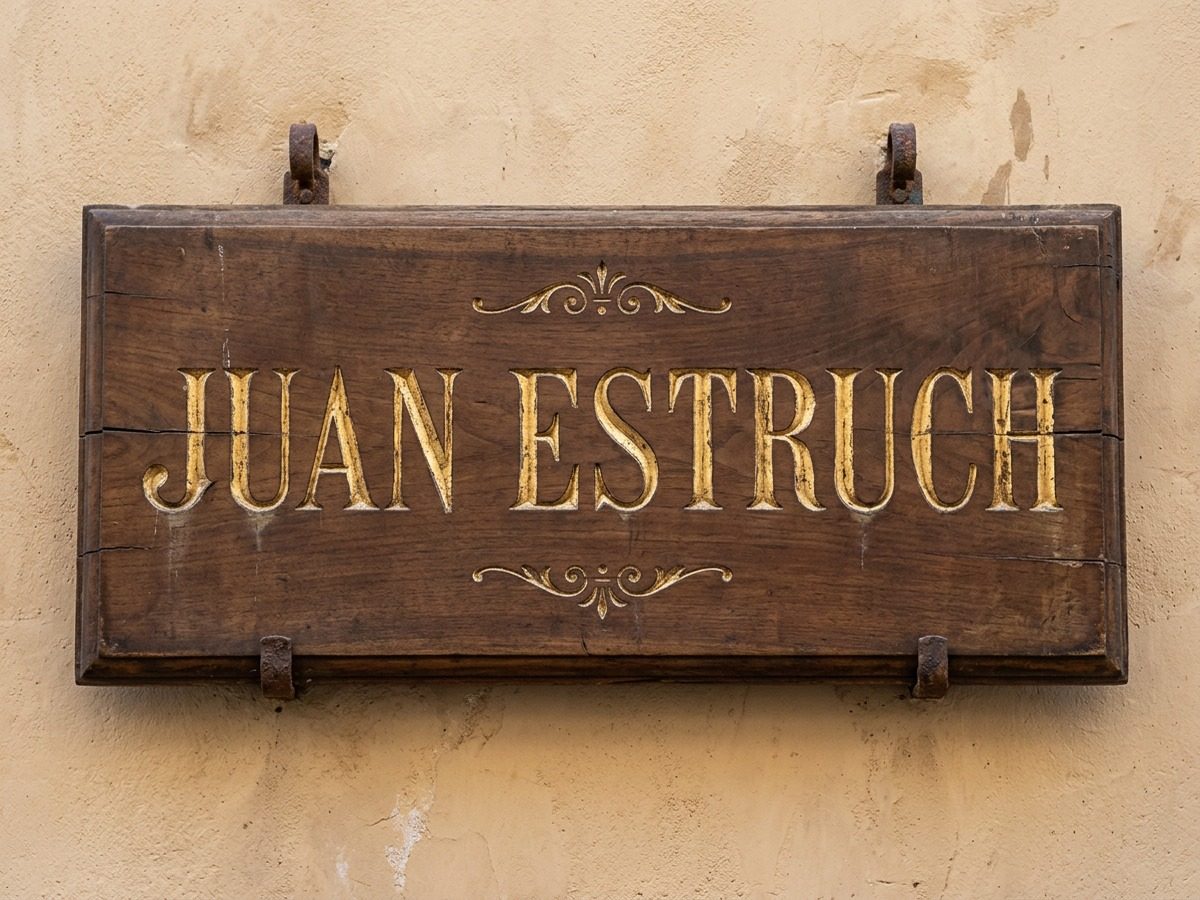
Joan, or Juan, Estruch Rosell built his first instrument in 1880. The Museu de la Música de Barcelona describes the workshop founded at that time as the oldest continuously operating guitar workshop in Catalonia. It was originally located on Carrer Ample in Barcelona, and the craft was subsequently continued by several generations of the Estruch family.
According to the workshop’s own history, the succession ran from Juan Estruch Rosell to Juan Estruch Sastre, who took over the family business after the Spanish Civil War, and later to Juan Estruch Pipó. Following Pipó’s death, management passed to Rafael Montes Ramírez, who had originally entered the workshop as an apprentice at the age of fourteen.
There is another important connection with Barcelona’s wider craft environment: the Estruch workshop also served as a place of training for other guitar makers, including Enrique Sanfeliu, according to the Museu de la Música. During the twentieth century it was more than a production site. In the 1960s and 1970s, the workshop became a meeting place for musicians associated with the Catalan singer-songwriter movement Nova Cançó, which played an important role in the cultural life of the region.
For this reason, Estruch is better understood not as a “pupil” of a particular school, but as an independent Catalan dynasty embedded in Barcelona’s broader environment of guitar making.
Does the Catalan Guitar Have a Distinctive Style?
Reducing an entire century of Barcelona guitar making to a single set of characteristics would be misleading. Instruments by García, Simplicio, Fleta and Estruch were made in different decades, by different makers and for different musicians.
It is more accurate to speak of a shared craft environment. Its defining features include continuity between workshops, close study of existing instruments, the development of the Spanish guitar’s structural heritage and, at the same time, a willingness among individual makers to modify construction details.
The term “Catalan school” is therefore more useful as a historical framework than as a technical standard. It helps explain why Barcelona produced several important workshops and why the relationship between master and apprentice may be just as significant as the maker’s place of birth.
Why This Tradition Still Matters
For collectors, the history of Barcelona guitar making provides a way to read an instrument more accurately. A surname on the label is only the beginning of the investigation. The period in which the workshop operated, the particular generation of a family, construction details and the relationship between a specific guitar and other documented instruments by the maker all matter.
This is particularly relevant to Estruch guitars. Instruments bearing the name were produced by several generations and during different periods in the workshop’s history. The name Juan Estruch alone is therefore not enough to establish the maker, date or place of manufacture of a particular guitar. Those details need to be checked against the label, construction and documented information about the individual instrument.
Guitar Heritage Shop & Club currently features instruments by Juan Estruch in its catalogue. Their precise place within the workshop’s history is considered separately and only after the date, model and attribution of each instrument have been confirmed.
This is the practical value of the Heritage section: not simply to list famous names, but to show the connections between an instrument, its workshop and its period. The Catalan tradition illustrates this especially clearly. Here, the history of the guitar is not the story of a single invention, but of a craft passed from hand to hand for more than a century.