

The Madrid School of Guitar Making

How One Workshop Shaped Several Generations
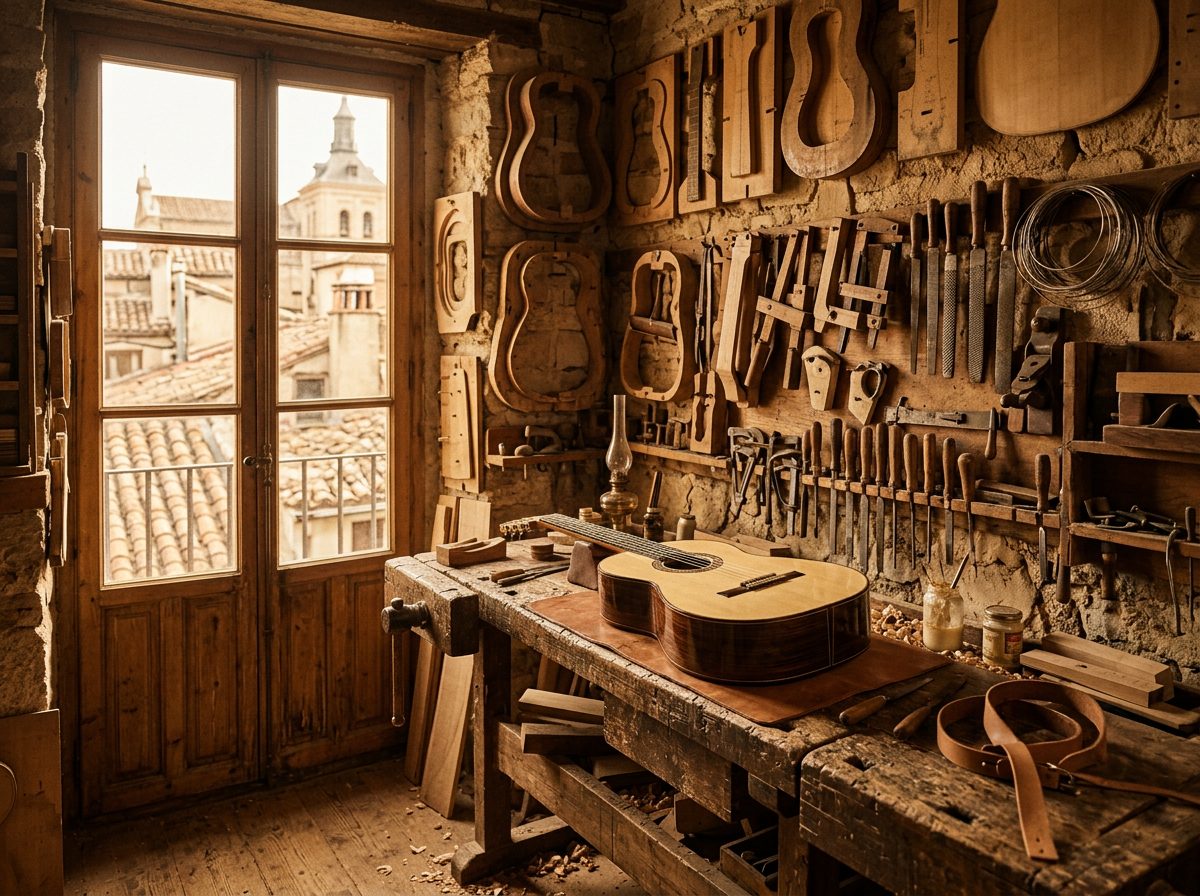
The history of the Madrid guitar is best approached not through the city itself, but through the workshop. In the late nineteenth and early twentieth centuries, workshops became the places where construction ideas passed from one person to another: an apprentice could later establish an independent business, modify what he had learned and, in turn, train the next generation of makers.
The term “Madrid school” is therefore best understood primarily as a network of continuity. Its representatives did not follow a single blueprint or build identical instruments. Yet Madrid offers one of the clearest examples of workshop lineages connecting the legacy of Antonio de Torres with the guitar of the twentieth century.
One of the central forces within this system was the Ramírez family.
From Torres to Madrid
During the second half of the nineteenth century, the construction principles developed by Antonio de Torres became a crucial point of reference for Spanish guitar makers. A larger body, a thin and responsive soundboard and fan bracing helped establish the model of the Spanish guitar around which later generations continued to experiment.
The Madrid tradition was not simply an imitation of Torres. Rather, makers adopted his ideas as a foundation that could be adapted to the concert stage, to the needs of particular performers and to an evolving musical language.
The Harris Guitar Collection at the San Francisco Conservatory of Music identifies Manuel Ramírez and Santos Hernández as makers who developed a distinct Madrid style while remaining within the broader tradition shaped by Torres.
José Ramírez I and the Beginning of a Dynasty
José Ramírez I founded the workshop from which one of the best-known dynasties in Spanish guitar making would later emerge.
The importance of this workshop extended beyond the instruments that carried the Ramírez name. It became a training ground for a whole circle of makers. This is why the history of the Madrid school cannot be read from labels alone: a craftsman might work within the Ramírez workshop, build instruments for it and later begin producing guitars under his own name.
One particularly important figure was José’s younger brother, Manuel Ramírez.
Manuel Ramírez and Segovia’s Guitar
Manuel Ramírez is regarded as one of the most important Madrid makers of the early twentieth century. The Harris Guitar Collection describes him as one of the first Madrid luthiers to fully understand the significance of Torres’s construction legacy. His workshop employed people who later became major figures in Spanish guitar making, including Santos Hernández and Domingo Esteso.
Manuel’s workshop is also connected with one of the most famous guitars of the twentieth century.
In 1913, the young Andrés Segovia, preparing for a performance in Madrid, came to Ramírez in search of a more suitable instrument. The guitar he eventually received was made in Manuel Ramírez’s workshop, with a significant part of the work attributed to Santos Hernández. Segovia used the instrument for almost a quarter of a century, including during his American debut in New York in 1929. Today, the guitar belongs to the collection of The Metropolitan Museum of Art.
The episode matters not only because of Segovia’s name. It demonstrates how closely the workshop and the performer were connected in Madrid. The guitar did not evolve in isolation: the demands of the concert musician became part of the maker’s work.
Santos Hernández: From Workshop to His Own Name
Santos Hernández began his professional career before joining Manuel Ramírez, but it was there that he rose to the position of senior craftsman. In 1909 he became head of production, and after Manuel Ramírez died in 1916, Hernández opened his own workshop.
He is particularly well known for flamenco guitars. However, the modern categories of “classical” and “flamenco guitar” should not be applied mechanically to the earlier period: in the early twentieth century, the distinction between these types was not yet as rigid as it later became.
This can be seen in Hernández’s own instruments. His guitars could use different materials and be built for different musical purposes. Flamenco instruments generally required qualities such as quick response, low action and low weight, with cypress traditionally associated with their backs and sides. Yet Hernández worked within the same broader Spanish construction tradition.
Domingo Esteso and the Continuation of the Line
Domingo Esteso also emerged from Manuel Ramírez’s workshop. Today, his name is especially associated with flamenco guitars, although this distinction again reflects a later way of categorising instruments.
The Harris Guitar Collection notes that Esteso’s instruments display an individual character while retaining links with the earlier Torres tradition.
The more important point is that a single workshop produced several makers who did not simply become copies of their teacher. They developed their own approaches. This capacity for branching and transformation is precisely what makes the term “Madrid school” useful.
Ramírez After the War
The history of the Ramírez family continued through José Ramírez II. After spending almost twenty years in South America, he returned to Spain and took over the family workshop in Madrid in 1925.
His period was extraordinarily difficult. The Spanish Civil War and the shortages of the post-war years severely restricted production. The Ramírez workshop itself emphasises that one of José II’s main achievements was simply preserving the family business under these conditions.
This is especially relevant to the Guitar Heritage catalogue. José Ramírez guitars dated 1941 and 1943 cannot automatically be attributed to José Ramírez III simply because the label bears the name José Ramírez. These dates belong to the period when the workshop was under José Ramírez II; the individual maker of each instrument must be established separately.
José Ramírez III and a New Concert Guitar
José Ramírez III began working in his father’s workshop at a young age and gradually became interested in construction experiments.
His name later became associated with a new phase in the development of the Ramírez concert guitar. Among the best-known changes were larger dimensions and scale lengths on some concert models, as well as the use of western red cedar for soundboards. Casa Ramírez dates the beginning of its work with cedar tops to 1965.
The 1A model that developed during this period became particularly closely associated with the later career of Andrés Segovia. The Harris Guitar Collection notes that instruments from the early 1960s reveal a transition from lighter construction closer to older traditions toward the newer concert concepts developed by Ramírez III.
What Is the Madrid School?
It would be misleading to reduce the Madrid tradition to a single “Ramírez sound.” Manuel Ramírez, Santos Hernández, Domingo Esteso, Marcelo Barbero and other makers worked within the same wider environment, yet their instruments differ considerably.
What unites them is not a single blueprint but the workshop as a mechanism for transmitting knowledge.
Madrid demonstrates particularly clearly that the history of the guitar is not made only by famous surnames. Sometimes it is more revealing to ask who worked with whom, who examined another maker’s instruments from the inside, who left one workshop to establish another.
For a collector, a Ramírez label is therefore not the end of attribution but the beginning of a question. Which generation of the family does it belong to? In what period was the instrument built? Who was working in the workshop at the time? What construction principles were being used?
Through such questions, the Madrid school becomes more than a list of famous names: it becomes the history of a living craft environment.