

Manuel Ramírez

Spanish guitar maker and representative of the Madrid School
Manuel Ramírez de Galarreta y Planell (1864–1916) was a Spanish guitar maker who worked chiefly in Madrid. He specialised in classical and flamenco guitars and played a notable part in the development of the Madrid school of guitar making in the late nineteenth and early twentieth centuries. Makers who trained in his workshop later became independent figures of Spanish guitar making: Santos Hernández, Domingo Esteso and Modesto Borreguero.
Manuel Ramírez was born in 1864 in Alhama de Aragón. The family normally lived in Madrid, but their father's work took them to Aragon for a time. Manuel learned guitar making from his elder brother José Ramírez I, the founder of the family's Ramírez workshop. In 1891, at the age of 27, he decided to set up on his own. He had originally intended to open a business in Paris and had his brother's support, but in the end he stayed in Madrid and established his own workshop at Calle de la Cava Baja, 24. This decision caused a long-lasting rift between the brothers.
Ramírez's workshop later moved to Plaza de Santa Ana and then to Calle de Arlabán, 10. Manuel gained the status of master to the Royal Conservatory in Madrid and continued to work within the craft tradition that had taken shape in the capital after the spread of Antonio de Torres's ideas. At the same time, his instruments were not a simple repetition of the models of earlier makers: Ramírez developed his own templates and construction solutions, especially in the field of the flamenco guitar.
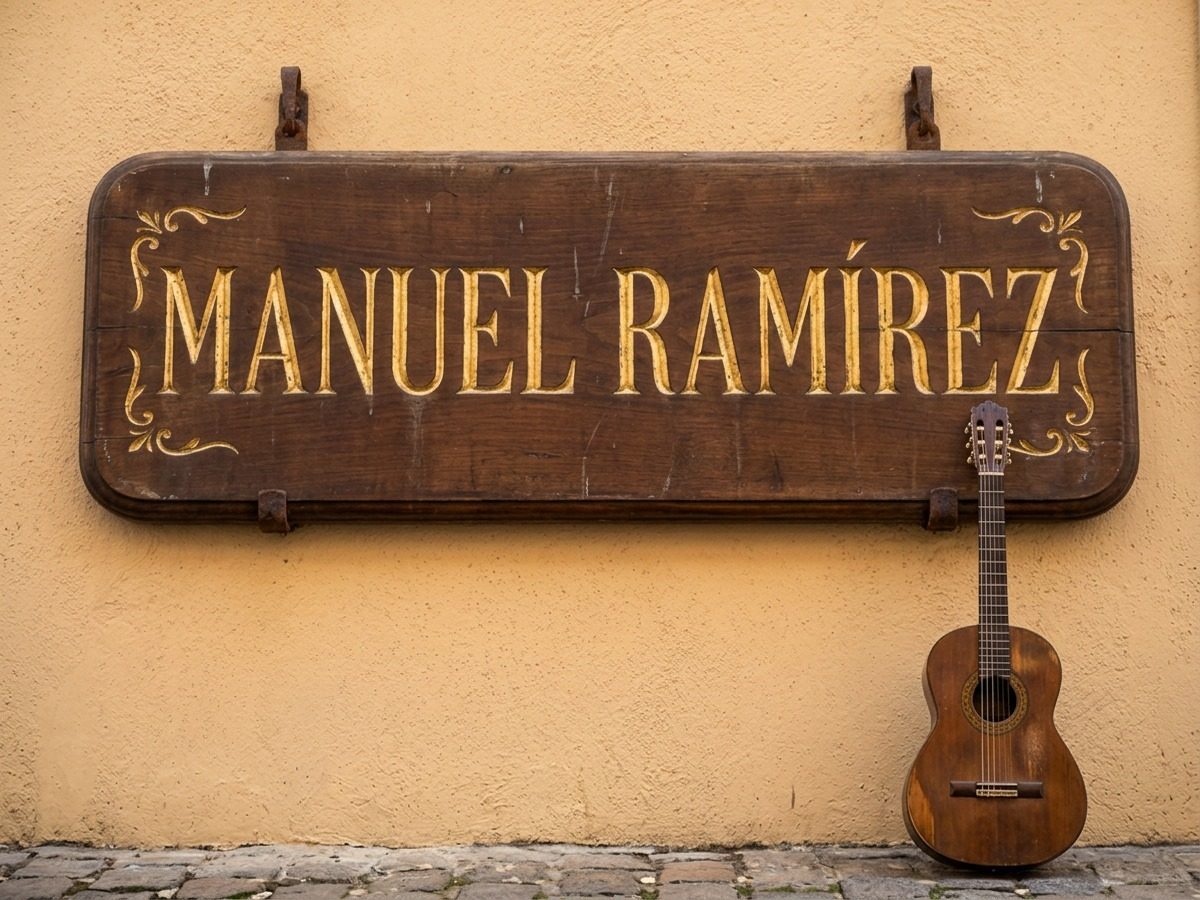
Work on the flamenco guitar
One of Manuel's starting points was the so-called guitarra de tablao, developed by his brother José Ramírez I. This model was created in response to the demands of café and tablao musicians, who needed a more audible instrument. Manuel went on building such guitars but gradually altered their shape and construction. The Ramírez family's materials link this work with the emergence of one variant of the flamenco guitar, which his pupils later used and developed.
That said, in the early twentieth century the division between classical and flamenco guitars was less rigid than it is today. The same workshops could build instruments for different performing purposes, and the features of a particular guitar depended on the materials, the construction and the client's requirements. Ramírez's contribution is therefore better seen as part of the gradual emergence of a distinct flamenco guitar design than as the creation of one standardised model.
The workshop and its pupils
Manuel Ramírez's importance lies not only in his own instruments but also in the way his workshop was organised. Santos Hernández, Domingo Esteso and Modesto Borreguero worked there. After Ramírez's death they continued for a time under the management of his widow, Filomena Vera Cervelló, using the “Viuda de Manuel Ramírez” labels while also marking the instruments with their own initials. Later, each of the main makers opened an independent workshop.
Domingo Esteso went independent around 1919–1920, Santos Hernández opened his own workshop in 1921, and Modesto Borreguero in 1924. Manuel Ramírez's workshop thus became one of the centres from which several independent lines of twentieth-century Madrid guitar making grew.
Andrés Segovia's guitar
Manuel Ramírez's name is linked with one of the most famous historical instruments of the Spanish guitar: the guitar of Andrés Segovia. According to the story given by Casa Ramírez, the young Segovia came to the workshop intending to hire an instrument for a concert at the Ateneo de Madrid. After hearing him play, Ramírez provided him with a guitar that went on to accompany the musician for many years. Today the instrument is in the collection of the Metropolitan Museum of Art in New York.
The attribution of this guitar also shows how historical Spanish workshops operated. The instrument is associated not only with the name of the business owner: Santos Hernández, one of the workshop's leading makers, took part in building it. Hernández later repaired the same guitar after he had begun working independently. Cases like this explain why a workshop label is not always the same as the personal authorship of a single individual.
Contribution and legacy
Manuel Ramírez died in 1916. His workshop carried on under his widow, and the makers he had trained built their own businesses and models. As a result, his influence reached several later generations of Madrid guitar making.
Ramírez's main contribution can be divided into three strands: the development of the Madrid construction tradition after Torres, a part in shaping the flamenco guitar of the early twentieth century, and the creation of a workshop that became a centre for training makers. His name is associated both with the classical concert guitar, above all through Segovia's instrument, and with the line of flamenco guitars carried on by Hernández and Esteso.
Today, instruments bearing Manuel Ramírez and Viuda de Manuel Ramírez labels require careful attribution. Their year, the type of label, the makers' initials, construction features and repair history all matter in assessing them. The collective nature of the workshop's work is precisely one of the key features of Manuel Ramírez's legacy.
Sources
Guitarras Ramírez: Manuel Ramírez's biography and the history of the Ramírez family.
Guitarras Ramírez: materials on the makers' initials and the workshop's work after Manuel Ramírez's death.
The Metropolitan Museum of Art and Casa Ramírez materials on Andrés Segovia's instrument.